




A root canal is a scary dental treatment for many, thanks to myths about its being painfully overwhelming. However, an informed mind has little room for fear. If you’ve got a thoroughly infected tooth or a decaying one damaging your inner tissues, a root canal is what your dentist needs to do to restore your dental health and preserve your tooth. A root canal procedure in Austin aims to save your tooth and take away that discomfort once and for all. It is an everyday, straightforward procedure performed by a dentist or an endodontist in Austin.
Pulp is the soft tissue inside a tooth containing the nerves and blood vessels. Infection of your teeth or their pulp causes extreme discomfort, irritation, swelling, and sensitivity. While this experience will undoubtedly tempt you to avoid seeking professional help, without appropriate treatment, the infection can only cause increasing discomfort for you. In this blog, we’ll guide you step-by-step through a typical root canal procedure.
Understanding the Reasons for Root Canal Treatment
A tooth needs root canal treatment in Austin when the pulp in its core becomes inflamed and infected, due to severe tooth decay, cracks, or trauma to the mouth or the tooth itself. Some signs that may prompt your dentist to recommend a root canal include toothaches, heightened sensitivity to heat and cold, and even swelling in the gums surrounding the affected tooth. If left unchecked, an infected tooth will result in the spread of the infection into your gums and bone structure, and the loss of your tooth entirely.

Root canal therapy is designed to remove the inflamed pulp within the tooth, clean and seal the canal thoroughly to prevent the infection from recurring. In doing so, your dentist or endodontist in Austin saves your tooth from being extracted and restores its function.
What Happens During The Root Canal Procedure?
The root canal process involves a series of stages to eliminate infected tissue, clean the tooth, and fill it to protect it. Understanding the whole process can help alleviate anxiety and reassure you about what to expect during successful treatment.
Stage 1: Initial Examination and Diagnosis
Before treating the tooth, your dentist or endodontist will first perform a detailed examination. This might involve taking an X-ray to assess the extent of the infection or damage. Then they will explain to you fully what a root canal in Austin entails and answer any questions you may have.
Stage 2: Administration of local anesthetic
To ensure you remain comfortable throughout the procedure, your dentist or endodontist will administer a local anesthetic to numb the area of the mouth around the affected tooth. Therefore, you should not feel any pain or discomfort during the operation. Most patients report just the pressure of something inside the mouth.
Stage 3: Accessing the pulp
Once the area is numb, the dentist will drill an opening at the top of the tooth to access the pulp chamber, where the nerves, blood vessels, and connective tissue are located. The dentist will carefully remove the infected and damaged tissue from this area to prevent future infection in the mouth.
Stage 4: Cleaning and Shaping of the root canals
The root canals are the pathways which are inside the tooth in which the nerves are located. The dentist will then clean the pathways to the root of the tooth and file them down, as this helps remove any lingering bacteria and dead tissue and is also required before sealing the canals.
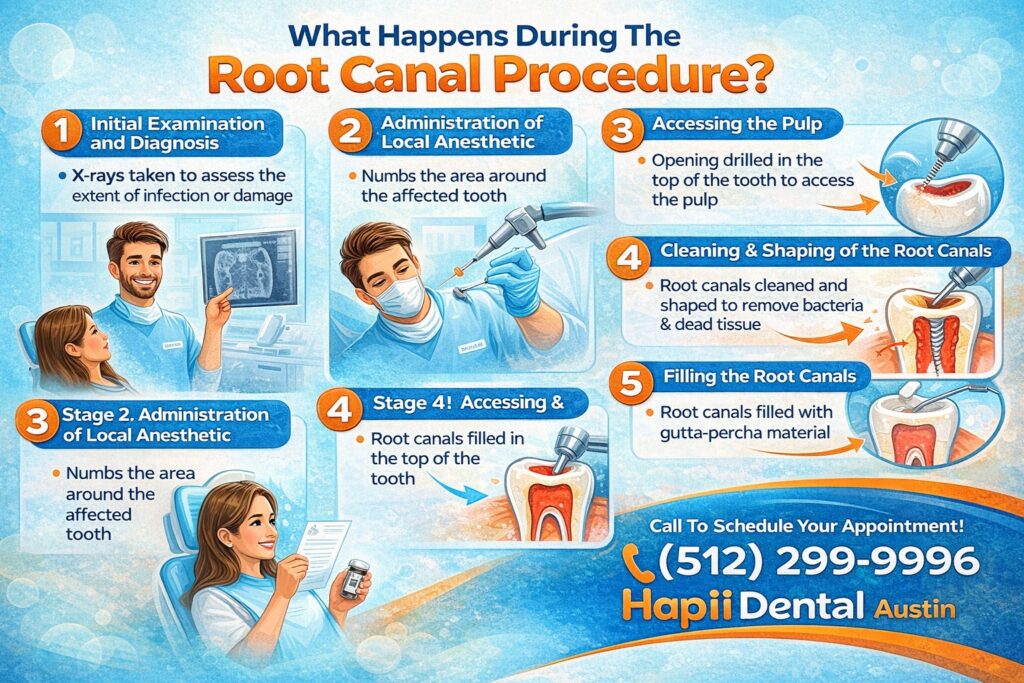
Stage 5: Filling the Root Canals
Once the root canals are cleaned and shaped, they are filled with a material known as gutta-percha. This is a plastic-like substance that will then seal the root canals, thus protecting the tooth from future infections and keeping it strong.
Stage 6: Sealing the tooth
After the root canals have been filled, the small hole on the top of the tooth is sealed, either temporarily or permanently, depending on the treatment plan. This may then require further work on the tooth, possibly a crown or other restoration, and will require a second appointment.
Stage 7: Recovery and Postoperative Care
The recovery from a root canal is usually quite simple. Any discomfort experienced after the treatment will fade over a few days. There may be some inflammation and tenderness, for which the dentist may prescribe medication.
Your dentist or endodontist will give you full instructions for post-operative care. This will include things like eating and drinking, as well as information about any medication that may be prescribed for your dental health.
The Advantages of a Root Canal Procedure
A root canal has many advantages, the main ones being saving your natural tooth from being pulled, relieving any pain you have, and fully restoring your tooth to its function. The root canal is the best way to ensure a tooth infection doesn’t persist, so it never reaches a stage where the tooth has to be extracted, and the overall look of your smile is compromised.
- Saving Your Natural Tooth: A root canal procedure is a great way to save your tooth, helping you avoid extraction.
- Alleviating the Pain: The perception is that a root canal causes pain, when in fact, it actually removes it.
- Restoring Function: once the procedure has been performed, the tooth functions fully, so you can smile, speak, and chew.
- Long-term Benefit: If treated well, root canal treatment is something that will help a tooth last your entire life.
Take the First Step Towards Relief
If you require a root canal in Austin, then the best thing to do is not to wait until the pain becomes unbearable. At Hapii Dental, we perform and manage root canals in Austin, providing comfort and ease throughout the whole procedure. Whether you require a routine root canal or an endodontist near Austin, we can provide treatment to restore your smile.
Call us now to book an appointment to fix your smile! We look forward to hearing from you here at Hapii Dental. Our team is ready to walk you through every step to ensure you are as comfortable as possible!
Questions People Ask About Root Canal Treatment
What are the signs that I need a root canal?
Common signs include severe tooth pain, sensitivity to hot or cold, and swelling in the gums. If you notice these symptoms, it’s important to consult with a dentist or endodontist in Austin.
Is the root canal procedure really painful?
No, root canal procedures are generally not painful. With modern anesthesia techniques, most patients experience minimal discomfort during the procedure and a quick recovery.
How long does it take to recover from a root canal?
Most people recover from a root canal within a few days. Some mild discomfort or swelling is normal but should subside quickly.
How do I care for my tooth after a root canal?
After your root canal, your dentist will provide you with specific aftercare instructions. These may include using over-the-counter pain relievers and avoiding chewing on the treated tooth until it is fully restored.
Can a root canal fail?
While root canal treatment is very effective, there is a small chance of failure. This can occur if the tooth becomes reinfected or if the procedure wasn’t completed properly.
Will I need a crown after a root canal?
In most cases, a crown is recommended to protect the tooth after a root canal. This helps restore the tooth’s strength and function, ensuring it lasts for many years.